Numun’s note: This is a blog post created by Burma Podcast Network, one of Numun’s nodes of organisers participating in Feminist Tech Playground 2.0 Connectivity & Crisis, to explore the question of how feminist networks, movements and communities can better prepare and care for ourselves in a context of multiple, interconnected crises, especially when it comes to ensuring continued ability to connect, share information and resources, organise, document and communicate.
The NIGHT
19 years ago…
It was 2 a.m. in 2007, just a few weeks after the Saffron Revolution
The whole country had risen. Monks, students, civilians filling the streets, asking for change, demanding freedom.
But that night, freedom felt very far away.
I was 13 years old. I was asleep, sharing a bed with my little sister. She was only 6.
And then,
BANG! BANG! BANG!
The sound of fists pounding against our front door shattered the silence.
My mom rushed into our room and whispered urgently to me:
“Take care of your sister. Stay quiet. Don’t make a sound.”
I didn’t understand what was happening. But I could feel fear enter the room.
Then I hear men shouting, Boots stomping, Doors slamming open. It was about twenty soldiers stormed into our house.
They were everywhere…searching, shouting, taking whatever they wanted.
I held my little sister tightly as she trembled next to me.
We didn’t know who they were.
We didn’t know why they were here.
All we saw were soldiers in military uniforms, holding machine guns.
Pointing them at my mother, and at my grandmother.
I remember thinking:
Why are they doing this to us?
What did we do wrong?
That night…was one of the most terrifying nights of my life.
NEXT MORNING
The next morning, everything felt different.
Quieter. Heavier.
My mom sat me down and said she and my dad had to go away for a while.
She told me not to be afraid. She told me my grandmother (dardee) would take care of us.
I nodded.
But inside my head, there were so many questions…
Why are you leaving?
Where are you going?
Why can’t we come with you?
But I didn’t ask.
ABOUT MY FAMILY
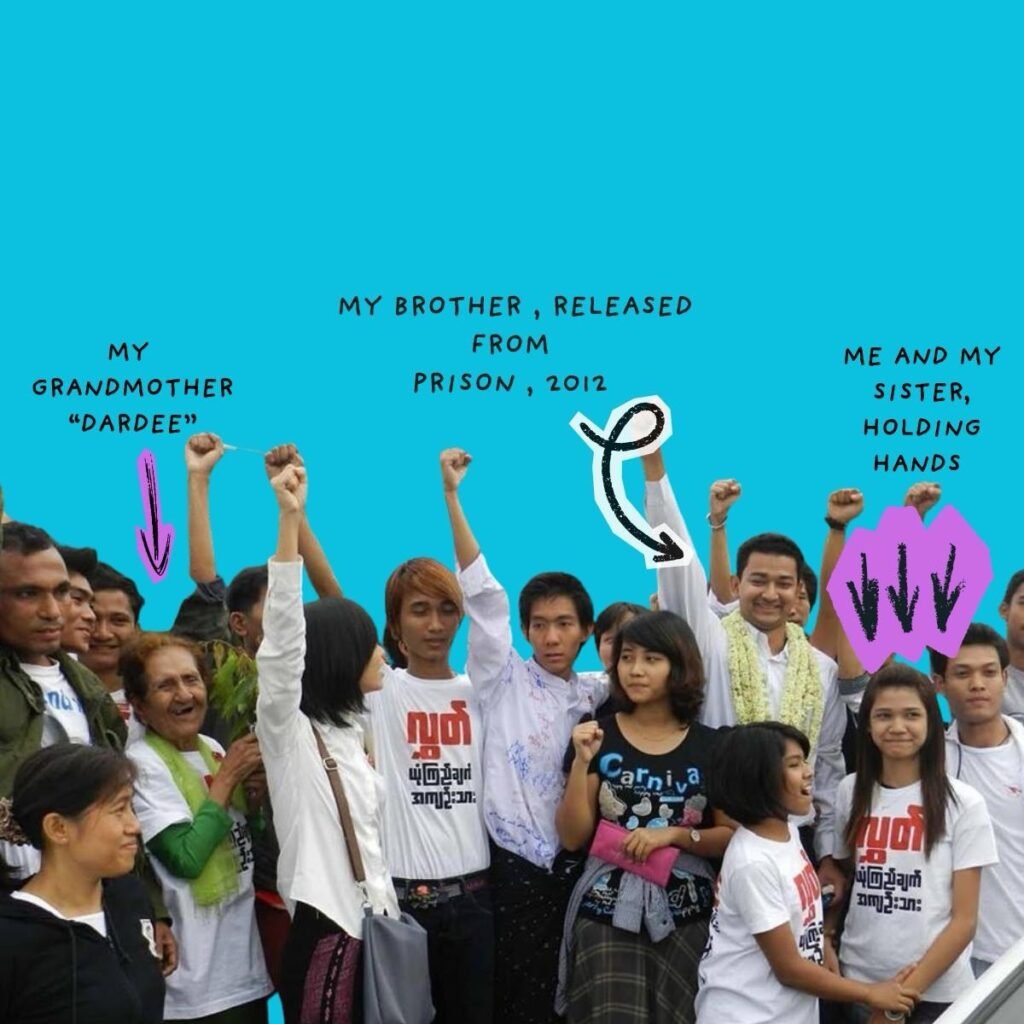
My name is Yar Yar. I was born and raised in Yangon, Myanmar.
And my family… was not an ordinary family. They were deeply involved in politics. My parents and my brother were not just participants, but prominent voices in the movement for democracy.
And because of that…
We were always a target. Our lives were never entirely our own.
WHAT HAPPENED AFTER THE RAID
A few days after the raid, my parents were arrested. They were sentenced to six years in prison.
My brother was sentenced to eleven years.
They took all of them. And they didn’t just imprison them. They scattered them.
My father was sent far away to the North.
My mother was sent to central Myanmar.
My brother was sent to a notorious prison near the Bangladesh border.
Not because it was necessary. But because it was cruel. Because distance is another kind of punishment. If they kept them far enough, we couldn’t visit or we couldn’t see them.
And they hoped that silence would break us.
There were only three of us left in our house:
An 80-year-old grandmother,
a 13-year-old girl,
and a 6-year-old child.
MY DARDEE’s MORNING RITUAL
Every morning at 7 a.m., my grandmother had a ritual.
She had this old Panasonic radio.
It wasn’t just a radio.It was hope for her.
She would carefully tune it..slowly, patiently…searching through static and noise…trying to catch signals from banned stations:
RFA.
VOA.
BBC.
Voices the military regime didn’t want us to hear. But voices we needed.
She listened every single morning. She listened for news about the country, about the political situation and most of all, for one possibility,
“Amnesty.”
A word that could bring our family back.
She did this… every day. For five years.
From 2007 to 2011.
Five years of listening…
Five years of waiting…
Five years of hoping…
HOW I FEEL
For me, that radio became something else. It became my alarm clock. I still remember the opening sound of RFA. That sound meant it was morning. It meant it was time to wake up, put on my school uniform, and pretend that life was normal. While my grandmother listened to the news, she would also prepare our lunchboxes. She would smile at us and sing songs for us. As if everything was okay. As if our family is not broken into pieces.
Looking back now, I realize something. Resilient doesn’t always seem loud and demonstrative.
It can be a simple routine of an 80-year-old grandma tuning a radio every morning refusing to give up hope.
It can be the letters from mother inside a solitary confinement cell.
It can be a 13-year-old girl, trying not to be afraid and not letting the tragedy torn apart her life.
HOW WE ARE COMMITTED TO DELIVER HOPE
This story is just a glimpse of my life. Just one chapter.
But it shaped everything that came after. It shaped how I see the world. How I understand silence and voice.Fear and courage. Oppression and resilience.
I grew up in a place where voices are silenced, I learnt something very important:
Voices matter.
Stories worth telling.
The broadcast must go on.
19 years later, my fight against the military regime did not end when I became a migrant and political exile. It simply changed form.
I found myself working alongside a community of tech-savvy youth, storytellers, and artists. Together, we continued that fight through the Burma Podcast Network, not with weapons, but with voices, stories, and access to information.
What we are building is not just content. It is a digital civic space. A place where people can speak, where human stories are not erased, where public debate is still possible, even in a time when silence is safer. In a country like Myanmar, that space matters more than ever.
Over the past four years, BPN has worked with dozens of local and international civil society organizations. Among them, Numun stood out for how they chose to support us. It was simple, and rare. No heavy reporting. No constant demands. Instead, they opened doors for us to learn from peer groups and offered subtle reminders of our role in protecting rights and standing together as a community.
With that support, we started building more than just episodes. We built systems. A website with a structured script library and an accessible archive, so people can not only listen, but also learn and reuse. At the same time, we ran community podcast lab experiments with youth and professionals. They were spaces to try, to fail, and to find new voices.
We also tested offline solutions. Small FM and MP3 devices with SD cards. Simple tools, but not simple to implement. Some worked. Some did not. But each attempt showed us something we did not know before.
Over time, one thing became clear. Sustainability does not come from doing everything ourselves. It comes from working with what already exists.
Today, BPN works with a community radio station to bring podcasts to places we cannot reach alone. Every Monday, our episodes are broadcast through FM frequency, reaching communities in Karenni and parts of Shan State. It is a small routine, but it carries voices further than we could on our own.
Without Numun’s support, we would not have had the resources, the space to experiment, or the inspiration we gained from other nodes in this movement to better serve our community.
In the past 18 months, we have grown into a steady node within that network. Not the biggest, not the loudest, but consistent.
How strange it feels to be on the other side of the radio after 19 years. My responsibility now is to broadcast small pieces of hope, and a reminder that we are still in this fight together.
Note : This personal memoir essay is my reflection on how helping the community voices to continue facing oppression and digital censorship are important in my country and all around the world. Not only for the young girls like I was but the major population of Myanmar are suffering daily internet shutdown, digital censorship, forced conscription, unlawful arrest and most brutally, killing the hopes.
About BPN
To date, BPN has produced 16 shows and more than 135 episodes, working with individuals and organizations from different fields. Our content reaches over 60,000 active listeners across Facebook, YouTube, TikTok, and other podcast platforms.
Our full-time committed production team, supported by research-based editorial work, ensures that every project we produce creates a positive impact for both the community and our collaborators.
Our mission is to promote analytical and critical thinking through well-crafted podcasts, amplify the voices of marginalized and under-represented professionals and active citizens, and inspire public awareness by connecting civic values with engaging, high-quality edutainment.